Reconcile the Intention
A Pattern for Adaptive Change Leadership by Michael Basil
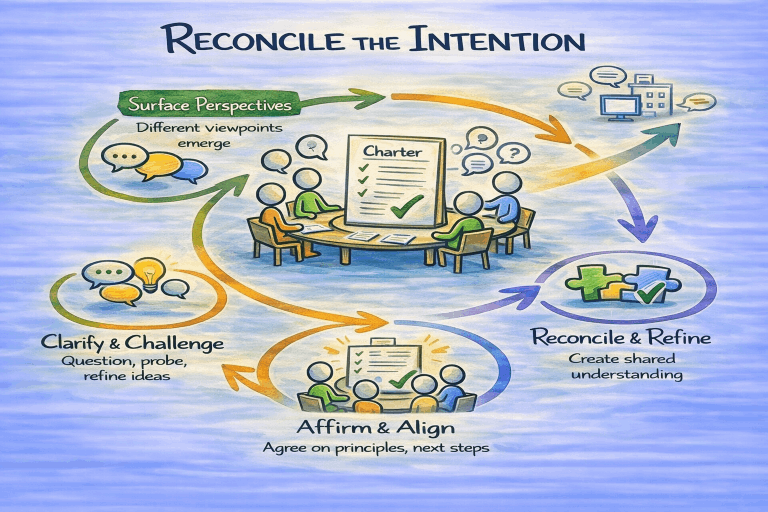
For leaders, facilitators, or change agents when a group struggles to act cohesively due to ambiguous priorities, fragmented mental models, or misaligned intentions.
Summary
Guide a group through structured, iterative conversations anchored on a visible alignment artifact—a charter, principles document, or other codified intention. The focus is on the conversation itself, surfacing ambiguity, reconciling perspectives, and creating shared understanding. Over time, this strengthens culture, clarifies roles, and aligns actions within and beyond the group.
Story
A department led a major initiative spanning multiple teams. They had a charter and principles on paper, but in practice, people held different interpretations. Misalignment caused duplicated effort, missed opportunities, and occasional friction.
A change leader introduced a series of conversations centered on a visible artifact—a living charter. Over several sessions, key participants revisited principles, clarified roles, and reconciled differences.
Some social leaders were quiet at first, others vocal. Each engaged through successive iterations until they could affirm the final artifact: “This captures our intent—and here’s why and how it helps in my role.”
As alignment grew, collaboration improved. Conversations with other teams became smoother. Decisions were clearer. The artifact became a reference point, visible to others, guiding interaction, supporting management decisions, and even providing context for automated systems downstream.
The result: a culture of iterative alignment and clarity—not just a document, but a living conversation that strengthens collective action.
Context
You are leading or supporting change inside a complex, ambiguous environment.
Existing charters or guiding documents may be stale, incomplete, or misunderstood. Mental models across the group are fragmented. People pursue initiatives in isolation. Stakeholders outside the group need clarity to collaborate effectively. Organizational culture rewards action but lacks structured spaces for alignment.
Without intervention, ambiguity persists, decisions remain reactive, and opportunities for coordinated impact are lost.
Problem
How do you help a group align when:
- principles are unclear or inconsistently understood
- key voices are isolated or not sufficiently aware of each other
- cultural norms drift away from formal charters
- leadership focuses on outputs rather than fostering shared understanding
- the organization lacks mechanisms to revisit performance, success metrics, or impact regularly
Conventional meetings or status updates rarely surface misalignment or build collective clarity. Without structured conversation, ambiguity persists, decisions remain reactive, and opportunities for coordinated impact are lost.
Forces
Iteration vs. Completion
Alignment requires revisiting, refining, and iterating; premature “agreement” hides ambiguity.
Visibility vs. Safety
Publishing an artifact signals intent but invites scrutiny; it must balance clarity with psychological safety.
Structure vs. Emergence
Formal documents provide reference and legitimacy, but alignment emerges through conversation and shared sense-making.
Internal vs. External Alignment
Principles must resonate within the group and also be interpretable by others interacting with or depending on the group.
Cultural Codification vs. Adaptation
Artifacts should capture culture and intent, but remain flexible to reflect new experiences, members, or priorities.
Solution
Reconcile the Intention.
Create a structured, iterative process around a visible alignment artifact:
- Identify or create the artifact (charter, principles, guiding document).
- Convene key participants, including social leaders and subject matter experts.
- Facilitate conversations that surface ambiguity, clarify principles, reconcile differences, and invite critique.
- Iterate until all key participants can affirm the artifact: “This is right, here’s why, and how it helps in my role.”
- Publish or share the artifact with relevant audiences to guide interaction, decisions, and future alignment.
The conversation is the value, not the artifact alone. Each iteration strengthens shared understanding, culture, and collective action.
Resulting Context
When the pattern succeeds:
- Mental models are aligned; ambiguity is reduced.
- Participants share a common language for intent, priorities, and principles.
- Interactions with other teams or departments become smoother, more predictable, and effective.
- Leadership gains a clear reference point to guide decisions, set priorities, and support the group.
- Teams understand which metrics matter, track progress over time, and revisit performance to inform alignment.
- The artifact becomes a living, iterative tool—anchoring culture, decision-making, and ongoing alignment across the organization.
Key Characteristics
- Focuses on conversation over documentation
- Uses a visible artifact as a touchstone for alignment
- Engages key participants iteratively, not just once
- Strengthens culture through repeated reflection and affirmation
- Provides clarity for external stakeholders and downstream systems
Failure Modes
Premature Agreement
Description: One meeting creates the illusion of alignment; key voices haven’t fully engaged.
Mitigation: Iterate, revisit, and engage social leaders multiple times until affirmation.
Artifact as Output Only
Description: Document exists but conversations never occur; culture remains misaligned.
Mitigation: Center the artifact on discussion, not completion.
Ignoring Cultural Ambiguity
Description: Subtle misalignments remain unaddressed; principles drift from practice.
Mitigation: Surface disagreements openly; revisit regularly.
Lack of Visibility
Description: Artifact remains internal; others interacting with the group remain unclear on intent.
Mitigation: Share with relevant audiences while balancing safety and scrutiny.
Overformalization
Description: Artifact becomes rigid, stifling reflection and adaptation.
Mitigation: Maintain iterative, conversational approach; allow principles to evolve.
Related Patterns
- Establish the Circle – Alignment artifacts rely on a functioning Circle for iterative review, discussion, and surfacing key tensions.
- Balance the Conversation – Balanced facilitation ensures the artifact accurately reflects diverse perspectives and produces actionable alignment.
- Fearless Change Patterns:
- Evolving Vision – Periodically revisit vision and priorities to maintain alignment over time.
- Concrete Action Plan – Define concrete next steps that anchor aligned intentions in observable outputs.
- Small Successes – Celebrate iterative progress to reinforce alignment and build credibility.
- Big Jolt – Showcase alignment achievements visibly to create momentum and influence adoption.
Explore in Your Context
Interested in:
- Introducing iterative alignment exercises
- Creating living artifacts for your team or department
- Strengthening cultural clarity and shared understanding