Energy Awareness Reflection
A Reflective Exercise for Understanding Energy in Conversation by Michael Basil
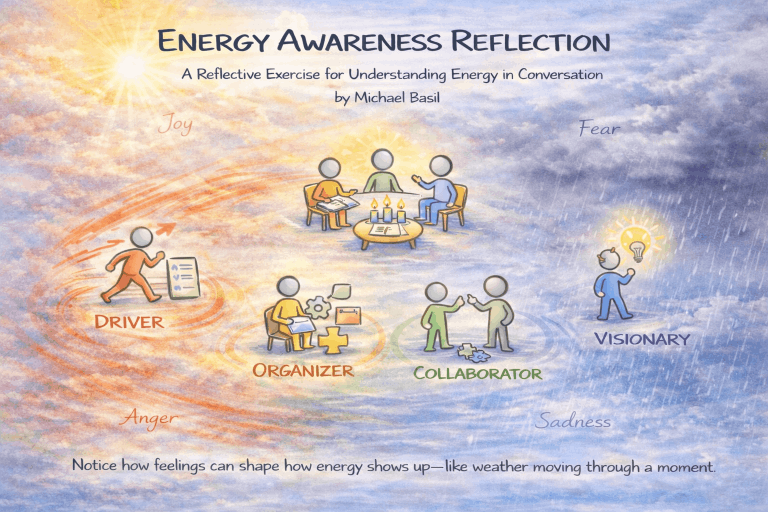
This exercise supports a structured reflection of how another person shows up across your conversations over time and in different emotional contexts.
It helps you notice patterns in how their presence shifts, stabilizes, or varies depending on what is present emotionally.
You’ll rate how strongly each type of energy shows up on a scale from 1 (barely there) to 10 (very strong).
Ways energy shows up
The framing below is based on the Focus Energy Balance Indicator (FEBI®) by Ginny Whitelaw.
A person may move through all of these depending on the situation, emotion, or conversation.
Driver
Driver energy is about action and forward movement—initiating, deciding, and helping things move.
Organizer
Organizer energy is about structure and clarity—planning, shaping, and making things workable.
Collaborator
Collaborator energy is about connection—listening, aligning, and building shared understanding.
Visionary
Visionary energy is about possibility—imagining, reframing, and opening up new directions.
The exercise
Take a moment to settle your attention before beginning.
Use a short mindfulness practice—such as following the breath, feeling the body, or sitting in quiet awareness—to help you slow down and become present.
- Suggested exercise: One Breath
Let your attention shift from immediate thinking into memory.
Engage the following prompts from that state of awareness.
1. Who is this reflection about?
Bring the person you are reflecting on to mind.
If you notice anything arising about this person, you might also pause and ask:
What am I actually noticing, versus what am I assuming?
2. Joy
Feeling open, engaged, or at ease
When joy is present across conversations, how strongly does each type of energy show up?
- Driver (1–10)
- Organizer (1–10)
- Collaborator (1–10)
- Visionary (1–10)
3. Sadness
Feeling low, quiet, or withdrawn
When sadness is present across conversations, how strongly does each type of energy show up?
- Driver (1–10)
- Organizer (1–10)
- Collaborator (1–10)
- Visionary (1–10)
4. Fear
Feeling uncertain, cautious, or on edge
When fear is present across conversations, how strongly does each type of energy show up?
- Driver (1–10)
- Organizer (1–10)
- Collaborator (1–10)
- Visionary (1–10)
5. Anger
Feeling activated, frustrated, or in tension
When anger is present across conversations, how strongly does each type of energy show up?
- Driver (1–10)
- Organizer (1–10)
- Collaborator (1–10)
- Visionary (1–10)
6. What stands out?
Looking across your responses for this person:
- What patterns do you notice in how this person shows up across emotional contexts?
- Where does their energy shift most across emotional contexts?
- What remains consistent over time?
Reflection
This reflection represents your current perception of how this person shows up across conversations in different emotional states.
This can support clearer awareness of what is actually happening between you in real time, relief from confusion or interpretations carried from past interactions, and new possibilities for how you understand and engage with this person going forward.
Sharing
One perspective brings useful clarity.
A second perspective adds contrast, and that contrast deepens understanding.
When a reciprocal perspective is added, you can see both what is shared and what is different. New dimensions emerge, and understanding between you becomes clearer and more complete.
If you choose to share it, you might begin simply with:
Would you be open to hearing a reflection I’ve been sitting with?
And invite the person to complete the same reflection from their side.
Continue exploring
If you’d like to go further with this work or explore additional dimensions, you’re welcome to connect.