Sense Making Reflection
A Reflective Exercise for Understanding How Reality Is Being Interpreted
by Michael Basil
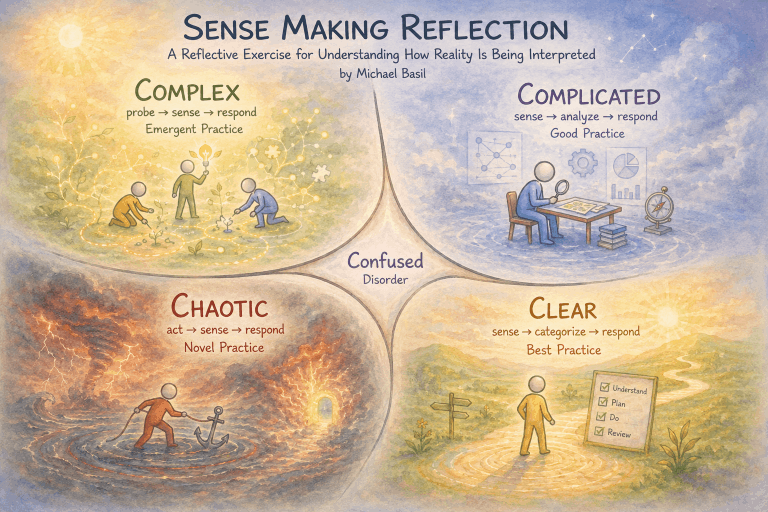
This exercise helps you notice how a person, group, or organization is interpreting what kind of situation they are in—and how that interpretation shifts across different conditions.
In real-world change processes, difficulty often does not come from the situation itself, but from people operating in different sense-making domains at the same time.
This can lead to friction, misunderstanding, and frustration—even when intentions are aligned.
This reflection helps make those underlying interpretive differences visible.
Sense-making domains
The framing below is based on the Cynefin framework developed by Dave Snowden.
Each domain reflects a different way of interpreting and responding to reality.
Clear
The situation is stable and understandable. Cause and effect are known, and established rules or best practices apply.
Approach: sense → categorize → respond using known practice.
Complicated
The situation requires analysis or expertise. Multiple possible answers may exist, and understanding emerges through investigation.
Approach: sense → analyze → respond using expert judgment or good practice.
Complex
The situation is uncertain and evolving. Cause and effect can only be understood in hindsight, and outcomes cannot be predicted in advance.
Approach: probe → sense → respond through adaptation.
Chaotic
The situation is unstable or highly disrupted. Immediate action is required to restore stability or create direction.
This may show up as:
- Reactive Chaos — stabilizing disruption quickly
- Generative Chaos — intentionally disrupting patterns to create new possibility
Approach: act → sense → respond.
Confused (Disorder)
There is no shared clarity about what kind of situation this is. Multiple interpretations exist simultaneously without a dominant frame.
This often appears when sense-making has not yet stabilized.
The exercise
Take a moment to settle your attention before beginning.
Use a short mindfulness practice—such as following the breath, feeling the body, or sitting in quiet awareness—to help you slow down and become present.
- Suggested exercise: One Breath
Let your attention shift from immediate thinking into memory.
Engage the following prompts from that state of awareness.
1. Who is this reflection about?
Bring the person, group, or organization clearly into mind.
This might be:
- an individual you are working with
- a team or leadership group
- a wider organization
- or yourself in a specific context
2. Default sense-making
When this person, group, or organization encounters situations in general, how do they tend to interpret what is happening?
- Clear
- Complicated
- Complex
- Chaotic
- Confused
3. Under uncertainty or change
When situations become unclear, shifting, or ambiguous, how does their interpretation tend to change?
- Clear
- Complicated
- Complex
- Chaotic
- Confused
4. Under pressure or disruption
When urgency, conflict, or instability increases, how does their interpretation tend to shift?
- Clear
- Complicated
- Complex
- Chaotic
- Confused
5. Stability of sense-making
Across situations, how consistent is their way of interpreting what is happening?
- Stable — consistent framing across contexts
- Partial — some shifts depending on context
- Variable — frequent shifts in interpretation
- Fragmented — multiple frames competing without coherence
6. What stands out
Looking across what you’ve noticed:
- What is their dominant way of interpreting situations?
- Where does their interpretation stay stable?
- Where does it shift most strongly?
- Where might others be operating from a different sense-making frame in the same situation?
Reflection
As you look across your responses, this reflection is pointing toward a working hypothesis about how sense-making is happening in this system.
You may begin to notice that what feels like resistance, confusion, or misalignment is often not about intent or capability—but about people operating from different interpretations of what kind of situation they are in.
When these differences are visible, coordination becomes easier to understand, even if it does not immediately resolve the difficulty.
Take a moment to notice:
- what feels coherent
- what feels inconsistent
- and where interpretation itself may be part of what is shaping the experience
Sharing
One perspective brings useful clarity.
A second perspective adds contrast, and that contrast deepens understanding.
When reciprocal reflections are shared, you can begin to see:
- where interpretations of the situation align
- where they diverge
- and where different Cynefin domains are operating in parallel
If you choose to share it, you might begin simply with:
Would you be open to exploring how we are each interpreting what kind of situation this is?
And invite the other person, group, or team to complete the same reflection from their side.
Continue exploring
If you’d like to go further with this work or explore additional dimensions, you’re welcome to connect.