The Evolution of Circle3 - Origin Story
Circle3 did not begin as a framework.
It began as something that kept happening.
In different places. With different people. Under different pressure.
The pattern kept repeating.
Long before there was language for it, it was already there.
Early attention to response
As a child, I spent time in my mother’s parrot store helping care for and tame large macaws.
Some were calm. Some were not.
What stayed was simple.
Attention mattered more than control.
When you pushed, things escalated.
When you slowed down and stayed present, something changed.
Not because you forced it.
Because you didn’t.
Trust showed up through pacing. Consistency. Stillness under pressure.
Nothing more complicated than that.
The same patterns in human systems
Years later, I saw it again.
Startups. Nonprofits. Universities. Enterprise systems. Community work. Personal life.
People trying to move forward together.
And something would break.
Communication would fragment. Meaning would split. Coordination would thin out under pressure.
What looked like resistance rarely was.
It was protection:
- stability
- identity
- credibility
- safety
- belonging
- meaning
People weren’t refusing change.
They were trying to stay intact inside it.
The first pattern: gathering attention
Without naming it, the same response kept appearing.
Bring people together.
Slow everything down.
Look at what is actually happening.
Not to fix it.
To see it clearly enough that it could be shared.
Something would shift.
Different perspectives would surface.
A shared language would begin to form.
Tension would become something the group could hold.
At some point, someone would say it out loud:
“We need a circle.”
Not a meeting.
Not a process.
A return to shared attention.
That became the first move.
Establish the Circle
A small, recurring center of shared attention where coherence can begin forming inside fragmentation.
When attention was not enough
Even when people were gathered, something else kept breaking.
They didn’t share the same sense of what they were doing.
Assumptions diverged.
Priorities drifted.
Meaning split quietly under pressure.
Alignment existed in conversation.
Not in lived reality.
So a second pattern appeared.
Reconcile the Intention
Alignment over agreement.
Making intention visible enough to return to when things shifted.
Over time this showed up as simple artifacts:
- mission statements
- guiding principles
- working agreements
- shared definitions of success
- team or group charters
- language for what “good” looks like
Not as documents.
As anchors for remembering.
When pressure exceeded capacity
And then something changed.
In my own life, periods of personal and professional hardship forced a deeper reevaluation of how coherence could be sustained under pressure.
Until then, the instinct had been simple:
Push harder. Solve faster. Keep momentum.
It worked—until it didn’t.
Eventually, that approach stopped producing coherence.
Things began to fragment in ways that effort alone could not resolve.
Not because the problems were bigger.
Because the response was no longer sufficient.
Integration was no longer something to think about.
It became something to recognize in real time—while things were still breaking.
Learning shifted from explanation to attention:
- noticing fragmentation as it is happening
- sensing when attention collapses
- recovering coherence step by step
- knowing when not to accelerate
- recognizing when effort stops helping
This changed the work.
Not as a concept.
As a constraint.
Influences that shaped what became visible
Only later did I find language and lineages that helped name what was already happening.
- Leadership practice by Ginny Whitelaw through Institute of Zen Leadership
- Aikido practice through Tenshinkan Dojo
- Negotiation practice by Chris Voss through Black Swan Group
- Sense-making framework by Dave Snowden through Cynefin
The emergence of perception: the lenses
As this continued, something else became impossible to ignore.
Even when a circle was formed.
Even when intention was clear.
People were not seeing the same thing.
The same moment would land differently depending on where someone stood inside it.
Not disagreement.
Different perception.
Different meaning.
Different reality, coexisting in the same room.
And over time, that pattern became visible enough that it could no longer be treated as background.
It had to be named.
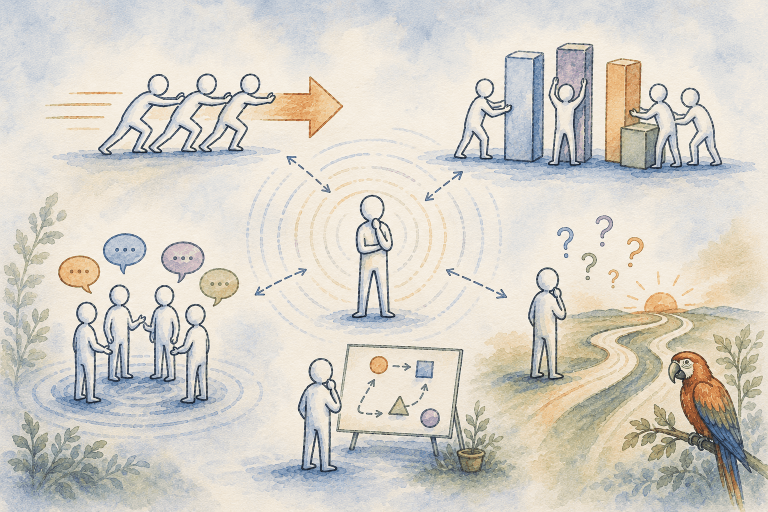
The lenses of Circle3
The third pattern
Once that became visible, something followed immediately.
Not as choice.
As necessity.
Something had to be done with that difference in perception.
Integrate the Conversation
Not directing the group.
Not forcing agreement.
Stepping out of direction and control.
Integration does not mean leveling differences or giving every perspective equal weight.
It means staying responsive to the conditions that allow coherence and shared insight to emerge as the conversation unfolds.
Attention, emotion, tension, and perception as a single field.
Keeping coherence possible while everything is still in motion.
The pattern stabilizes
Over time, three movements kept appearing:
- Establish the Circle
- Reconcile the Intention
- Integrate the Conversation
Not designed.
Recognized.
Repeated.
Continuing evolution
Circle3 is not finished.
It keeps forming through practice, breakdown, recovery, and return.
That’s still the stance.
The intention
Not to remove tension.
Not to simplify complexity.
But to create enough coherence for people to move through change together without breaking apart.
Especially when everything is moving fast.