Establish the Circle
A Pattern for Adaptive Change Leadership by Michael Basil
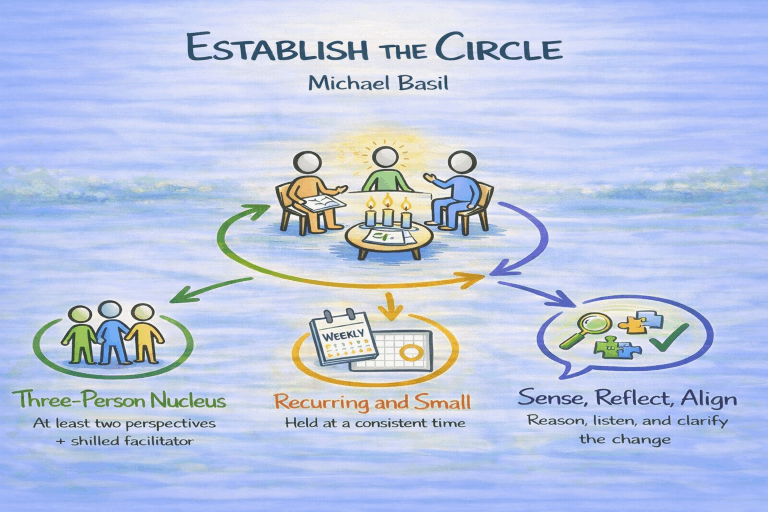
For leaders, facilitators, or change agents when people care about the change, but can’t connect, align, or move together.
Summary
Create a small, recurring conversational nucleus where participants representing different perspectives reason together about a change initiative. Guided by an integrative facilitator, the Circle develops shared understanding, connects isolated champions, and becomes a nucleus of alignment and coordinated momentum.
Story
A large enterprise organization was attempting to introduce a new initiative affecting multiple teams. Leaders wanted faster progress while maintaining safety and governance. Practitioners were overwhelmed with competing priorities. Stakeholders held conflicting interpretations of what the change meant.
Conversations about the initiative occurred everywhere: project meetings, hallway conversations, and internal messaging channels, but rarely in a place designed for shared understanding.
As a result, awareness was uneven, desire was fragmented, and potential champions remained isolated.
A change leader introduced a simple practice: a weekly gathering called the Circle.
At first, only three people attended: a technical practitioner, a second subject matter expert from another perspective, and a facilitator skilled in guiding reflective conversation.
The sponsor was aware of the effort but only loosely involved.
Week by week, the group reasoned together about the change. They surfaced tensions, listened to concerns, and gradually invited others when it made sense.
Over time the Circle became the place where people came to make sense of the change. Champions began connecting with each other. Shared language emerged.
Gradually, small islands of coherence began forming across the organization.
But it all began with one move:
Establish the Circle.
Context
You are leading change that crosses roles, teams, or areas of expertise and requires people with different perspectives to develop enough shared understanding to move together.
Problem
The people and perspectives needed for coherent change are distributed across roles, teams, or parts of the system, but there is no recurring place where they can develop shared understanding and coordinated momentum together.
This breakdown appears when:
- People hold different interpretations of the change, making it difficult to reach shared understanding and coordinate action toward the same direction.
- Champions are isolated from one another, limiting their ability to connect, form coalitions, and build enough collective momentum to influence the broader system.
- Leadership is structurally distant from lived experience, creating gaps between decisions about the change and the realities of those doing the work, so decisions can miss what only direct experience reveals.
- The organization is saturated with competing initiatives, fragmenting attention and making it difficult to sustain enough focus on the deeper causes of the situation rather than reacting to surface symptoms.
Typical responses rarely help: large meetings often become performative rather than reflective, and broadcast communication increases awareness but rarely creates commitment.
Forces
Hierarchy vs. Experience
Decision makers hold formal authority high in the structure, while those experiencing the change operate deeper in the organization. Decisions can therefore be made without the full benefit of the experience of those doing the work, while practitioners may lack the authority to act on what they see.
Coordination vs. Attention Scarcity
The organization needs coordinated change, but people’s attention is already fragmented across many initiatives, producing activity that’s locally useful but poorly coordinated with the larger system.
Expertise vs. Integration
Different subject matter experts understand different parts of the system, but their perspectives can remain separated within their domains. Each perspective may be locally valid while the combined picture remains fragmented, making it hard to see how the parts fit together.
Action vs. Reflection
Organizations reward visible action and execution, while meaningful change often requires time to reflect, make sense of experience, and integrate what has been learned. Pressure to demonstrate progress can therefore crowd out the reflection needed for coherent action.
Solution
Establish the Circle.
Create a small, recurring conversational nucleus where people with different perspectives can reason together long enough for shared understanding and coordinated momentum to form.
Do this by:
- Form a three-person nucleus with at least two subject matter perspectives plus facilitation capability.
- Mechanism: diversity of perspective plus a small, trusted space prevents early groupthink and allows tensions to surface safely.
- Effect: the group can see the same initiative from multiple realities without fragmenting.
- Include an integrative facilitator who can move the room between grounding and expanding, inquiry and action, and listening and integration.
- Mechanism: active facilitation converts scattered observations into usable shared meaning.
- Effect: conversations become progressively more coherent instead of cyclical or performative.
- Meet weekly at a consistent time and keep the core intentionally small (three to seven regular participants).
- Mechanism: cadence builds relational memory; small size preserves candor, accountability, and depth.
- Effect: shared language and trust accumulate fast enough to influence live change decisions.
- Involve sponsors lightly at first and invite additional participants selectively when learning or progress requires it.
- Mechanism: visible sponsorship provides legitimacy while selective participation protects conversational quality.
- Effect: insights can spread outward without collapsing the core space.
Use this move as an operating container, not a status forum. When drift appears, use the Failure Modes below as a diagnostic and coaching aid.
Resulting Context
When this move takes hold, the change has a stable conversational nucleus where different perspectives can be brought into relationship and examined together.
Participants develop shared language and shared interpretation, potential champions become connected, and concerns can surface earlier rather than remaining isolated across the organization.
The Circle becomes a nucleus of alignment from which more coordinated decisions and durable commitments can emerge. As the work develops, it can remain a small recurring Circle or evolve into a broader coalition, community of practice, or formal working group.
Known Uses
The story above comes from enterprise change work, but the core move (creating a small, recurring space for collective sense-making) shows up in many domains.
This pattern appears in practice in organizational, community, and personal settings where change requires ongoing collective sense-making rather than one-time communication.
Examples include:
- Agile, DevOps, and organizational transformation efforts within enterprise IT organizations, where recurring Circles connected isolated champions across teams.
- Financial-services technology organizations navigating competing priorities, resource constraints, and complex stakeholder environments.
- Learning communities such as the Mindset and Agile Dojo, where Circle gatherings supported reflection, peer learning, and cross-functional relationship building.
- Governance settings such as homeowner association and condominium boards, where recurring conversations helped stakeholders build shared understanding before decisions.
- Community dialogue and relational practice environments exploring collective reflection, belonging, and relational coherence.
- Informal family and friendship systems where a recurring conversational container helped participants navigate ongoing tensions and change.
Key Characteristics
- Begins with three people
- Includes at least two subject matter perspectives
- Includes an integrative facilitator
- Meets weekly
- Operates initially informally
- Invites participation as needed
Failure Modes
The Circle Becomes a Status Meeting
Description: Conversations focus on reporting progress rather than reasoning together, turning reflection into routine updates.
Mitigation: Refocus on inquiry and sense-making; the facilitator guides participants to explore tensions and perspectives, not just report status.
Dominance by Authority
Description: Senior leaders or sponsors overpower discussion, reducing psychological safety and stifling honest dialogue.
Mitigation: Ensure leaders participate lightly; the facilitator actively creates space for all voices.
Lack of Facilitation
Description: Without a skilled integrative facilitator, discussions drift, become unfocused, or are dominated by the loudest voices.
Mitigation: Include an experienced facilitator to guide conversation, surface tensions, and help the group move between reflection and action.
Excessive Growth
Description: Too many participants dilute intimacy, making conversations shift toward presentation rather than exploration.
Mitigation: Keep the core group small (3–7 people) and invite others selectively when their perspectives are needed.
Isolation from the Organization
Description: If the Circle becomes disconnected from the broader system, insights fail to spread and the Circle loses its coherence role.
Mitigation: Encourage participants to share insights outside the Circle and connect with relevant stakeholders.
Premature Formalization
Description: Rapid institutionalization can squash openness, turning the Circle into a rigid governance body.
Mitigation: Maintain informality initially; allow the Circle to evolve naturally before codifying structures.
Overstaying Its Welcome
Description: Continuing the Circle after its purpose is fulfilled can drain energy, create redundancy, and stifle emergent structures.
Mitigation: Periodically review the Circle’s relevance; adjourn, evolve, or spin off new groups when the original goal has been achieved.
Related Patterns
- Integrate the Conversation – Integrative facilitation keeps the Circle generative under pressure so diverse voices remain usable for alignment.
- Reconcile the Intention – Recurring conversation around shared principles or artifacts carries emerging understanding forward and helps make it usable for coordinated action.
Fearless Change Patterns
- Ask For Help: Engage key participants early to strengthen the nucleus and expand reach.
- Study Group: Form a small learning or reflective group to support iterative reasoning.
- Go-To Person: Identify people who can unblock issues and bring critical perspectives to the early Circle.
- Future Commitment: Encourage participants to make small commitments that sustain engagement over time.
Explore in Your Context
This pattern becomes meaningful when applied in your own change effort, not just understood conceptually.
If it resonates with your work, consider:
- Where are people interpreting the same change differently?
- Which champions are isolated and could benefit from a shared space?
- What small step could help you start a Circle of your own?
If you’d like to deepen this work:
- Unpacking this further
- Sharing a similar method
- Starting a Circle