Integrate the Conversation
A Pattern for Adaptive Change Leadership by Michael Basil
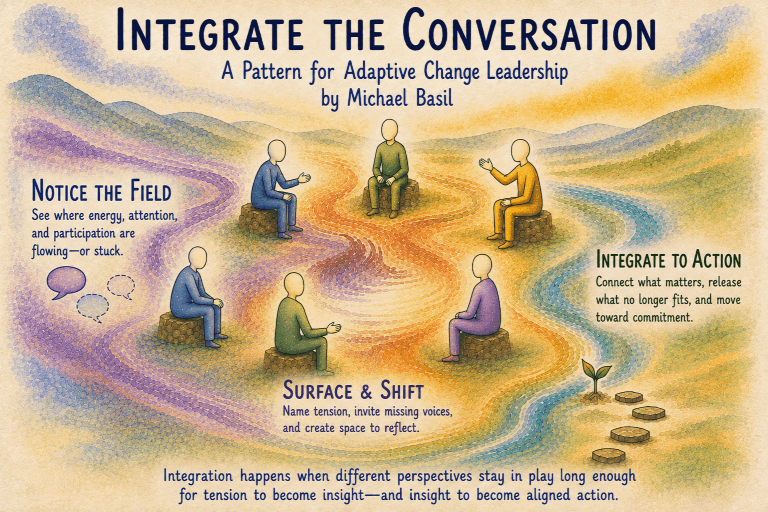
For facilitators, team leads, or change agents when everyone wants progress, but energy and focus are stuck in fragmented conversations.
Summary
Guide attention, surface perspectives, and shift tension so insight flows. Without integration, drivers clash, organizers silo, collaborators disengage, and ideas fail to translate into action. By intentionally observing and shifting energy, a facilitator helps the group integrate perspectives, make decisions, clear outdated priorities, and move toward aligned action.
This pattern is both independent and foundational, nourishing the effectiveness of the Circle itself. It enables subsequent moves like Reconcile the Intention and creates the conditions to establish, evolve, or adjourn a Circle, forming a more collaborative and responsive conversation system.
Story
In a large enterprise, a team had been meeting for months, generating ideas but failing to act. Visionaries dominated with unbounded ideation. Drivers clashed over priorities. Organizers focused on silos. Collaborators withdrew, feeling unheard. Decisions stalled, and outdated priorities persisted, leaving frustration and confusion in their wake.
A change leader entered the conversation and observed the group’s dynamics. They intervened with small shifts: grounding ideas, inviting cross-silo perspectives, and creating space for quieter voices. Using affect labeling (“It seems like we’re frustrated”) followed by dynamic silence, the group began to surface and process stuck tension.
Over time, participants cleared out ideas and priorities that no longer made sense, integrated perspectives, and made aligned commitments. Strategic initiatives that had stalled began producing tangible deliverables: completed, showcased, and connected to broader goals. Conversations shifted from fragmented debate to a collaborative, flowing system, where energy, insight, and action moved in harmony. The group became capable of learning, adapting, and responding to volatility and ambiguity in real time.
Context
You are facilitating a change conversation involving multiple perspectives, roles, priorities, and forms of expertise that need to contribute to shared understanding and coordinated action.
Problem
The conversation contains perspectives, information, priorities, and relational energy that are individually meaningful but are not being integrated into a shared understanding the group can act on.
This breakdown appears when:
- Drivers clash while organizers silo their perspectives, making it difficult to connect urgency and coordination across the system even when each perspective is legitimate on its own.
- Visionaries dominate and collaborators disengage, causing important perspectives and information to disappear from the conversation and eroding the participation needed to turn possibility into shared understanding.
- Ideas accumulate but fail to integrate, and outdated priorities persist, so the conversation keeps generating possibilities without producing coherent priorities or decisions that fit the current situation.
- Tension or frustration blocks aligned action, consuming emotional and relational energy that could otherwise support sense-making, integration, and movement.
Without integration, discussions remain fragmented, performative, and unproductive, preventing aligned action and learning.
Forces
Speaking vs. Listening
Some participants dominate the conversation while others hold back. More speaking can increase expression without increasing understanding, while too little participation leaves important perspectives unheard, making integration difficult.
Speed vs. Reflection
The group pushes toward decisions before perspectives are integrated, or reflects without moving forward. Pressure for visible progress can make reflection feel like delay, while insufficient reflection can lead the group to act before it understands what it is seeing.
Control vs. Emergence
Attempts to direct the conversation can restrict insight and participation, while too little direction allows the conversation to drift. The facilitator must provide enough structure to maintain coherence without controlling what the group discovers.
Divergence vs. Convergence
Ideas can expand faster than the group can connect and prioritize them. Too little divergence limits what the group can see, while too much divergence without convergence leaves ideas fragmented and prevents clear priorities and action from emerging.
Solution
Integrate the Conversation.
Keep multiple perspectives in play and actively work with the tension among them until differences can become shared insight, clearer priorities, and coordinated action.
Do this by:
- Observe conversational energy and participation patterns in real time.
- Mechanism: naming who is dominant, quiet, or disconnected reveals where information flow is constrained.
- Effect: the facilitator can intervene with precision instead of reacting globally.
- Apply targeted integration moves: ground abstractions, widen siloed viewpoints, and introduce focus when drift appears.
- Mechanism: alternating expansion and convergence helps the group hold divergence without losing direction.
- Effect: ideas become connected, prioritized, and actionable.
- Surface stuck emotion and tension using affect labeling followed by dynamic silence.
- Mechanism: affect labeling can reduce emotional reactivity and create reflective space for reorientation; the silence that follows gives the group room to reorient.
- Effect: defensive energy converts into usable shared attention.
- Guide explicit release of outdated assumptions or priorities and confirm next commitments.
- Mechanism: deliberate closure prevents legacy positions from silently governing decisions.
- Effect: the group can move forward with clearer commitments and less hidden friction.
These shifts require practice and ongoing calibration. When the conversation begins to degrade, use Failure Modes as an in-session diagnostic and coaching reference.
Resulting Context
When this move takes hold, the group can remain coherent while holding divergent perspectives, priorities, and tension. Differences that previously fragmented the conversation can be surfaced and integrated into shared understanding, clearer priorities, decisions, and commitments.
The group becomes better able to work through tension without either forcing premature agreement or losing direction. Conversation becomes more collaborative, responsive, and adaptive as circumstances change.
Over time, strategic initiatives move with less friction, and the Circle becomes more capable of establishing, evolving, and reconciling intention under changing conditions.
Known Uses
The story above is set in an enterprise team, but the facilitation challenge (integrating diverse perspectives and keeping dialogue productive under pressure) recurs across many domains.
This pattern appears in practice wherever groups need to integrate diverse perspectives, work through tension, and maintain productive dialogue under uncertainty.
Examples include:
- Enterprise transformation initiatives where leaders, practitioners, and stakeholders needed to reconcile competing priorities.
- Cross-functional planning and decision-making sessions where dominant voices, siloed thinking, or unresolved tension limited progress.
- Facilitation of Agile, DevOps, and systems-thinking workshops involving participants with different roles, incentives, and mental models.
- Mindset and learning communities that use facilitated dialogue to support reflection, peer coaching, and collective learning.
- Community dialogue and relational practice environments focused on developing deeper listening, awareness, and mutual understanding.
- Informal mediation and relationship-repair conversations among families, friends, and volunteer organizations.
Key Characteristics
- Focuses on group energy, not just content.
- Facilitator attuned to patterns, pauses, and dynamics.
- Acts as a harmonizing force rather than a controlling authority.
- Supports diverse perspectives and participation styles.
- Iterative and adaptable within each conversation.
- Enables the Circle to emerge, evolve, and sustain aligned action.
Failure Modes
Over-Pressing
Description: Pushing too hard to force integration leads to resistance or withdrawal.
Mitigation: Pause, observe, and gently guide energy shifts.
Over-Loosening
Description: Allowing fragmentation to persist can stall decisions or diffuse accountability.
Mitigation: Introduce structure or focus when appropriate.
Personalization of Conflict
Description: Tensions escalate into personal disputes.
Mitigation: Reframe conflicts around ideas, deepen understanding, and coach individuals directly when needed.
Avoiding Commitment
Description: Participants hesitate to make decisions or articulate priorities.
Mitigation: Facilitate small, low-risk commitments to build confidence.
Ignoring Field Dynamics
Description: Failure to read group patterns causes interventions to miss the mark.
Mitigation: Continuously observe, reflect, and adjust facilitation.
Related Patterns
- Establish the Circle – Integrative conversations sustain the nucleus so the Circle has a stable home for working with group energy.
- Reconcile the Intention – Integrative facilitation helps alignment exercises surface all perspectives so artifacts stay meaningful and actionable.
Zen Leadership Patterns
- Driver: Brings focus, urgency, and movement toward decisions and action.
- Organizer: Creates structure, clarity, and coordination across people and work.
- Collaborator: Builds connection, inclusion, and shared understanding across perspectives.
- Visionary: Expands possibility, introduces new ideas, and challenges current thinking.
Fearless Change Patterns
- Time for Reflection: Use structured pauses to observe group energy and recalibrate.
- Plant the Seeds: Introduce ideas strategically to encourage participation and contribution.
- Personal Touch: Engage individuals meaningfully to surface otherwise silent perspectives.
- Just Do It: Small iterative interventions maintain momentum without overplanning.
Practical Resources
Developing the ability to integrate a conversation requires reflection and practice. These resources offer complementary lenses for noticing how meaning, energy, and paradigm shape what happens in the conversation.
Sense Making Reflection
Understand how different interpretations of a situation shape coordination, decision-making, and alignment, and where misalignment emerges when people are operating from different sense-making frames.
👉 Explore
Energy Awareness Reflection
Build awareness of how relational energy is showing up in your conversations, and how your interventions influence attention, tension, and participation.
👉 Explore
Paradigm Awareness Reflection
Notice when a survival paradigm—protection, defensiveness, withdrawal, or the need to be right—is constraining the conversation, so the group can find the courage and neutrality that make integration possible.
👉 Explore
Explore in Your Context
This pattern becomes meaningful when applied in real conversations, not just understood conceptually.
If it resonates with your work, consider:
- Where are conversations becoming fragmented or stuck?
- Which voices or perspectives are dominating, and which are missing?
- What small shift could help restore integration and move the group forward?
If you’d like to deepen this work:
- developing or formalizing a Circle in your organization
- practicing conscious facilitation and conversational micro-moves
- working more intentionally with relational energy in teams and systems