Reconcile the Intention
A Pattern for Adaptive Change Leadership by Michael Basil
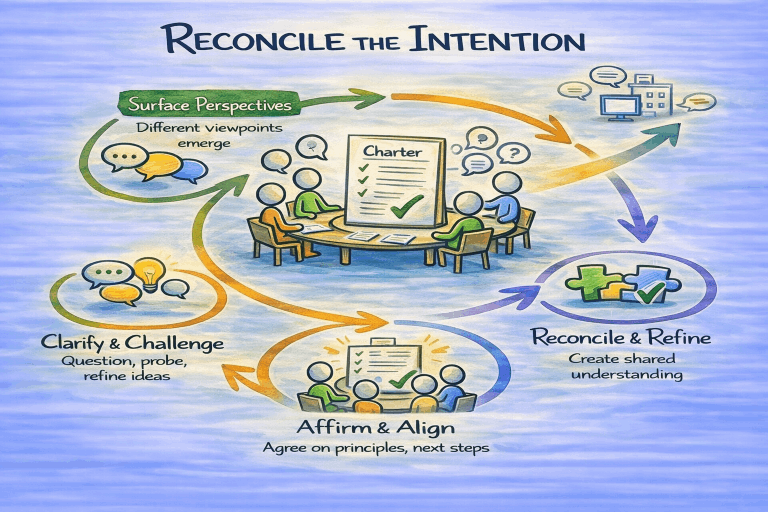
For leaders, facilitators, or change agents when a group struggles to act cohesively due to ambiguous priorities, fragmented mental models, or misaligned intentions.
Summary
Guide a group through recurring conversations around a visible representation of the intention. The conversation surfaces differing interpretations, tests them against experience, and develops shared understanding; the artifact carries that understanding forward between conversations. Over time, this strengthens culture, clarifies roles, and supports coordinated action within and beyond the group.
Story
A department led a major initiative spanning multiple teams. They had a charter and principles on paper, but in practice, people held different interpretations. Misalignment caused duplicated effort, missed opportunities, and occasional friction.
A change leader introduced a series of conversations centered on a visible artifact: a living charter. Over several sessions, key participants revisited principles, clarified roles, and reconciled differences.
Some social leaders were quiet at first, others vocal. Each engaged through successive iterations until they could affirm the final artifact: “This captures our intent, and here’s why and how it helps in my role.”
As alignment grew, collaboration improved. Conversations with other teams became smoother. Decisions were clearer. The artifact became a reference point, visible to others, guiding interaction, supporting management decisions, and even providing context for automated systems downstream.
The result: a culture of iterative alignment and clarity, not just a document, but a living conversation that strengthens collective action.
Context
You are leading change where an existing intention—expressed through principles, a charter, a working agreement, or another shared direction—must be interpreted and acted on by multiple participants and stakeholders.
Problem
The group has a stated intention but no reliable way to continually reconcile how that intention is interpreted, understood, and acted on across people, roles, and changing situations.
This breakdown appears when:
- Principles are unclear or inconsistently understood, making it difficult for participants to interpret priorities consistently and coordinate decisions and action.
- Key voices are isolated or not sufficiently aware of one another, so participants may hold valid perspectives without those perspectives being reconciled into shared understanding.
- Cultural norms drift away from formal charters, creating a gap between stated intention and lived practice and weakening the artifact as a guide for decisions and interaction.
- Leadership focuses on outputs rather than fostering shared understanding, allowing visible progress to occur while different interpretations and unresolved ambiguity persist underneath.
- The organization lacks mechanisms to revisit performance, success metrics, or impact regularly, allowing the original intention to become disconnected from what the group is learning, what success now means, and what the situation requires.
Conventional meetings or status updates rarely surface these forms of misalignment or create the conditions for resolving them. Without structured, recurring conversation, ambiguity persists, decisions remain reactive, and opportunities for coordinated impact are lost.
Forces
Iteration vs. Completion
Alignment requires enough iteration to surface ambiguity, test meaning, and refine understanding, while the group also needs enough completion to make the intention usable. Premature completion can create the appearance of agreement while ambiguity remains unresolved; endless iteration can prevent the group from turning understanding into a usable reference.
Structure vs. Emergence
A formal artifact provides structure, continuity, and a stable reference point, while genuine alignment emerges through conversation and shared sense-making. Too much structure can make the artifact rigid and disconnected from experience; too little structure leaves the conversation without a common reference for working through differences.
Internal vs. External Alignment
The intention must make sense to the people inside the group while also being understandable and useful to people who interact with or depend on the group. Optimizing only for internal understanding can create confusion at organizational boundaries; optimizing only for external clarity can produce an intention that does not reflect the group’s lived reality.
Cultural Codification vs. Adaptation
Codifying principles helps preserve and communicate culture and intent, while changing circumstances require those principles to be revisited and adapted. A rigid artifact can become disconnected from reality; an artifact that changes without enough continuity provides no stable reference for behavior and decisions.
Solution
Reconcile the Intention.
Bring the group into recurring conversation around a visible representation of the intention so that differing interpretations can be surfaced, tested against experience, reconciled, and carried forward into action.
Conversation and artifact evolve together: the conversation creates shared understanding, while the artifact makes that understanding visible and available for continued use.
Do this by:
- Establish or refresh a visible alignment artifact (charter, principles, or working agreement).
- Mechanism: a shared reference externalizes assumptions so they can be examined collectively.
- Effect: ambiguity becomes visible and discussable rather than remaining implicit.
- Convene key participants, including social leaders and subject matter experts, for structured alignment conversations.
- Mechanism: bringing influence and expertise together makes different interpretations visible while they can still be explored.
- Effect: differences can be reconciled before they become execution friction.
- Run iterative dialogue cycles: clarify language, test practical implications, invite critique, and revise.
- Mechanism: repeatedly testing the intention against different perspectives and practical situations turns abstract agreement into shared, role-level understanding.
- Effect: participants can understand not only what the intention says, but why it matters and how it applies in practice.
- Continue until key participants can affirm the artifact: “This is right, here is why, and this is how it helps in my role.”
- Mechanism: explicit affirmation tests whether participants understand the intention, can explain its relevance, and can see how it guides their own work.
- Effect: the artifact becomes a living coordination tool rather than a document that merely records agreement.
- Share the artifact with relevant internal and external stakeholders.
- Mechanism: visibility creates a common reference for decisions, interfaces, and accountability across organizational boundaries.
- Effect: collaboration becomes more predictable because participants can orient to the same visible intention.
The conversation is the value, and the artifact carries that value forward between conversations. The artifact is not the alignment itself; it is the visible, evolving representation of understanding created through the conversation. As circumstances change, the group can return to the conversation, test the artifact against experience, and adapt it. Use Failure Modes to diagnose drift when alignment appears present on paper but weak in practice.
Resulting Context
When this move takes hold, the group has a shared and sufficiently stable understanding of the intention that participants can explain it, apply it in their roles, and use it to coordinate decisions across boundaries.
The artifact becomes a trusted reference point that carries shared understanding between conversations without becoming a rigid substitute for them. When experience, priorities, or circumstances change, the group has a reliable way to return to the intention, test it against what has been learned, and adapt together.
Alignment becomes more durable without becoming fixed. Leadership gains a clearer reference for decisions, teams can evaluate performance and impact against shared intent, and stakeholders have a common basis for continued coordination and adaptation.
Known Uses
Although the story above comes from an enterprise initiative, the underlying move of iterative alignment through recurring conversations anchored on a shared, visible artifact appears in many domains.
This pattern appears in practice in settings where groups rely on recurring conversations around a shared artifact to create alignment and coordinated action.
Examples include:
- Enterprise technology organizations seeking shared language around DevOps, systems thinking, and cultural transformation.
- Leadership teams aligning around strategic priorities, decision-making frameworks, or measures of success.
- Agile and organizational transformation efforts using charters, principles, working agreements, or operating models to guide change.
- Governance environments where boards or committees use documented agreements to guide decisions and stakeholder engagement.
- Learning communities that periodically revisit principles, practices, and expectations as participation grows and evolves.
- Emerging community experiments that use shared values, agreements, or purpose statements as living artifacts for ongoing alignment.
Key Characteristics
- Focuses on conversation over documentation
- Uses a visible artifact as a touchstone for alignment
- Engages key participants iteratively, not just once
- Tests intention against practical experience and different perspectives
- Uses repeated affirmation to strengthen shared understanding
- Allows the artifact to evolve as circumstances change
- Provides a shared reference for internal and external coordination
Failure Modes
Premature Agreement
Description: One meeting creates the appearance of alignment before key voices have fully engaged or important ambiguities have been explored.
Mitigation: Iterate, revisit, and engage key participants multiple times until they can genuinely affirm the artifact and explain how it applies in their role.
Artifact as Output Only
Description: The document is completed, but the conversations that create shared understanding never occur or stop once the document exists.
Mitigation: Center the artifact on recurring discussion, testing, and revision. Treat the conversation as the value and the artifact as the visible carrier of that value.
Ignoring Cultural Ambiguity
Description: Subtle differences between stated principles and lived practice remain unaddressed, allowing the artifact to drift away from how people actually work.
Mitigation: Surface differences openly and revisit the artifact against experience, decisions, and observed behavior.
Lack of Visibility
Description: The artifact remains hidden from relevant participants or stakeholders, so different groups continue operating from different assumptions about intent.
Mitigation: Share the artifact with relevant audiences while balancing the need for visibility with appropriate safety and scrutiny.
Overformalization
Description: The artifact becomes rigid or authoritative, making it harder for participants to question, learn from, or adapt the intention as circumstances change.
Mitigation: Maintain the iterative, conversational approach and allow the artifact to evolve as experience reveals what needs to change.
Related Patterns
- Establish the Circle – Alignment artifacts rely on a functioning Circle for recurring review, discussion, and surfacing key tensions.
- Integrate the Conversation – Integrative facilitation helps the conversation surface diverse perspectives and tensions so the artifact can reflect meaningful, actionable alignment.
Fearless Change Patterns
- Evolving Vision: Periodically revisit vision and priorities to maintain alignment over time.
- Concrete Action Plan: Define concrete next steps that anchor aligned intentions in observable outputs.
- Small Successes: Celebrate iterative progress to reinforce alignment and build credibility.
- Big Jolt: Showcase alignment achievements visibly to create momentum and influence adoption.
Explore in Your Context
This pattern becomes meaningful when applied to your own alignment challenges, not just understood conceptually.
If it resonates with your work, consider:
- Where do principles or charters exist on paper but aren’t functioning as living alignment tools?
- Which key voices haven’t yet affirmed a shared understanding of intent?
- What artifact could anchor recurring conversation rather than sit as a one-time document?
If you’d like to deepen this work:
- Introducing iterative alignment exercises
- Creating living artifacts for your team or department
- Strengthening cultural clarity and shared understanding